Small investors face a unique challenge in real estate: competing for deals against larger players with deeper pockets and faster capital access. The financing solution you choose can mean the difference between closing a profitable deal and watching it slip away to a better-funded competitor.
This guide breaks down eight financing options specifically suited for small-scale real estate investors—from hard money loans that close in days to creative strategies like seller financing. Each option serves different investment scenarios, timelines, and risk tolerances. Understanding which tool fits your situation helps you move decisively when the right opportunity appears.
1. The Hard Money Co.
Best for: Investors who need fast closings and transparent communication on time-sensitive deals
The Hard Money Co. is a professional hard money lender that handles everything in-house, from underwriting to servicing, eliminating the delays that come with outside approvals.

Where This Tool Shines
The biggest advantage is speed combined with reliability. When you’re competing against cash buyers or facing tight deadlines, waiting weeks for a conventional lender isn’t an option. The Hard Money Co. makes all lending decisions internally, which means no third-party delays or surprise rejections after you’ve tied up a property.
The company funds 30 to 50 loans monthly from roughly 500 applications, reviewing thousands of deals annually. That volume translates to experience recognizing what works and what doesn’t—quickly.
Key Features
In-House Underwriting: All lending decisions happen internally without outside approvals that slow down timelines.
Real-Time Visibility: Borrower and broker dashboards provide transparency throughout the loan process, so you always know where things stand.
Professional Communication: Organized process from application through closing, with clear expectations at every stage.
Post-Funding Management: In-house servicing means you work with the same team after closing, not a third-party servicer.
Proven Track Record: Nearly 200 Google reviews with ratings approaching five stars demonstrate consistent performance.
Best For
This solution works best for investors who prioritize certainty and speed over finding the absolute lowest rate. If losing a deal costs you more than the difference in financing terms, fast decision-making and reliable closings matter most. It’s particularly valuable for fix-and-flip projects where renovation timelines are tight and delays compound quickly.
Pricing
Contact The Hard Money Co. directly for current terms. Pricing reflects the speed and flexibility that hard money provides—the opportunity cost calculation is whether the deal gets done, not just the rate.
2. Kiavi
Best for: Tech-savvy investors who prefer online platforms and have established deal experience
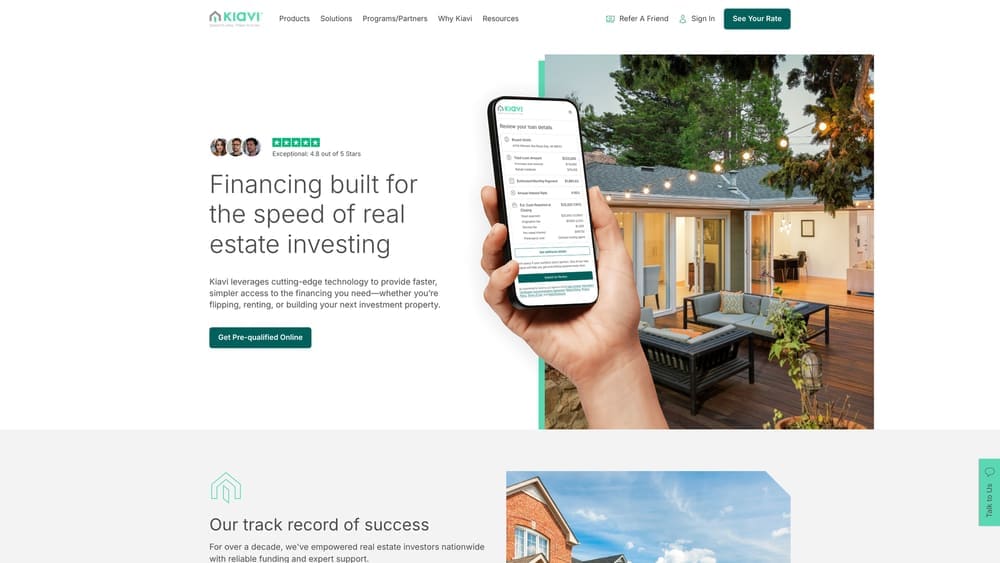
Kiavi is a technology-forward lender offering fix-and-flip and rental loans through a streamlined digital platform.
Where This Tool Shines
Kiavi built its platform specifically for experienced investors who want efficiency. The entire application and approval process happens online, which appeals to investors comfortable with digital workflows. You can track your loan status, submit documentation, and communicate with the team without phone tag or paper forms.
The platform works particularly well for investors who already have a track record and want to scale their operations. Kiavi’s systems are designed to move quickly once you’re in their ecosystem.
Key Features
Digital-First Platform: Complete applications, submit documents, and track approvals entirely online without traditional paperwork delays.
Fix-and-Flip Financing: Loans structured specifically for renovation projects with funding for both acquisition and construction.
Rental Property Loans: Long-term financing options for buy-and-hold investors building rental portfolios.
Portfolio Programs: Options for investors managing multiple properties simultaneously.
Draw Management: Renovation funding released in stages as work progresses, protecting both lender and borrower.
Best For
Kiavi works best for investors who have completed multiple deals and can demonstrate experience. The platform assumes a baseline level of real estate knowledge, so it’s less suited for absolute beginners still learning the fundamentals.
Pricing
Rates and terms vary based on loan type, property details, and borrower experience. More experienced investors with stronger track records typically qualify for better terms.
3. Lima One Capital
Best for: Growing investors who want multiple financing products under one lender relationship
Lima One Capital is a national lender offering diverse loan products including fix-and-flip, rental, and new construction financing.

Where This Tool Shines
Lima One’s strength lies in product diversity. Instead of working with different lenders for different project types, you can finance fix-and-flips, rental acquisitions, and even ground-up construction through one relationship. This matters when you’re scaling because established lender relationships often lead to faster approvals and better terms over time.
The company understands that serious investors don’t fit neatly into single categories. Your strategy might include flipping some properties while holding others as rentals, and Lima One’s product lineup accommodates that reality.
Key Features
Multiple Loan Products: Access fix-and-flip, rental, and new construction financing through one lender relationship.
Renovation Draw Schedules: Structured funding releases for fix-and-flip projects as work reaches completion milestones.
Rental Portfolio Loans: Financing designed specifically for buy-and-hold investors building long-term cash flow.
New Construction Options: Ground-up development financing for investors ready to build rather than renovate.
Relationship Benefits: Repeat borrowers often experience smoother approvals as the lender learns their investment approach.
Best For
Lima One works particularly well for investors who are actively growing their portfolios and need flexibility across different project types. If your strategy includes both short-term flips and long-term holds, consolidating financing under one lender simplifies your operations.
Pricing
Pricing varies by product type, property characteristics, and borrower profile. Investors with established track records and multiple projects typically access more competitive terms.
4. Fundrise
Best for: Beginning investors building capital while gaining real estate exposure passively
Fundrise is a real estate crowdfunding platform allowing small investors to gain diversified real estate exposure with low minimum investments.

Where This Tool Shines
Fundrise solves a specific problem: how to participate in real estate when you don’t yet have capital for direct property ownership. The platform pools investor funds to acquire properties across different markets and asset types, providing exposure without the responsibilities of property management, tenant issues, or renovation headaches.
This approach works well for investors who are accumulating capital for future direct investments while still generating returns from real estate. It’s passive income that requires no operational involvement on your part.
Key Features
Low Entry Threshold: Minimum investment requirements significantly lower than direct property ownership.
Diversified Portfolio: Exposure across multiple properties and markets reduces concentration risk.
Passive Management: No tenant calls, renovation decisions, or property maintenance responsibilities.
Quarterly Liquidity: Options to access invested capital quarterly, though real estate investments should still be viewed as relatively illiquid.
Professional Management: Experienced teams handle property selection, management, and eventual disposition.
Best For
Fundrise makes sense for investors who want real estate exposure but aren’t ready for direct property ownership. It’s particularly useful for building capital while learning about different markets and property types before committing to your first acquisition.
Pricing
Fundrise charges an annual advisory fee based on invested capital. The fee structure is transparent and disclosed upfront, covering platform operations and professional management.
5. LendingOne
Best for: Rental property investors who qualify based on property cash flow rather than personal income
LendingOne specializes in DSCR loans that qualify borrowers based on property income instead of personal tax returns or W-2 income.

Where This Tool Shines
DSCR loans change the qualification equation entirely. Instead of proving personal income through tax returns, you qualify based on the property’s ability to generate rental income that covers the mortgage payment. This matters tremendously for self-employed investors, those with complex tax strategies, or anyone whose personal income documentation doesn’t reflect their actual financial capacity.
The debt service coverage ratio measures whether rental income exceeds the mortgage payment by a sufficient margin. If the property cash flows properly, you can qualify regardless of how your personal income appears on paper.
Key Features
Property-Based Qualification: Approval based on rental income and property cash flow rather than personal income documentation.
No Income Verification: No need to provide tax returns, W-2s, or other personal income documentation.
Long-Term Rental Financing: Loan terms designed for buy-and-hold investors building rental portfolios.
Portfolio Programs: Options for investors financing multiple rental properties simultaneously.
Flexible Documentation: Streamlined process focusing on property performance rather than borrower employment history.
Best For
LendingOne works exceptionally well for self-employed investors, those with significant write-offs that reduce taxable income, or anyone whose personal income documentation doesn’t align with their actual financial strength. If the property cash flows properly, you can qualify even when conventional lenders would decline based on personal income.
Pricing
Rates and terms depend on the property’s debt service coverage ratio and overall financial performance. Stronger cash flow typically results in better loan terms.
6. Seller Financing Arrangements
Best for: Investors who can negotiate directly and find motivated sellers willing to act as lenders
Seller financing is a creative strategy where property sellers act as the lender, allowing buyers to bypass traditional lending requirements through direct negotiation.
Where This Tool Shines
Seller financing eliminates the institutional lender entirely. Instead of qualifying through a bank or private lender, you negotiate terms directly with the property owner. This opens opportunities that wouldn’t exist otherwise—properties that don’t qualify for conventional financing, sellers who prioritize deal certainty over immediate cash, or situations where traditional lending timelines would kill the transaction.
The flexibility is unmatched. Down payment amounts, interest rates, amortization periods, and balloon payment timing all become negotiable points rather than fixed institutional requirements. You’re limited only by what you can negotiate with the seller.
Key Features
Negotiable Terms: Every aspect of the financing—down payment, rate, term length—is subject to direct negotiation.
No Traditional Qualification: No credit checks, income verification, or institutional underwriting requirements.
Flexible Down Payments: Down payment amounts can be structured based on what works for both parties rather than institutional minimums.
Creative Structuring: Options for interest-only periods, balloon payments, or other arrangements that fit both parties’ needs.
Faster Closings: No lender approval process means transactions can close as quickly as title work allows.
Best For
Seller financing works best for investors who can identify motivated sellers and negotiate effectively. It’s particularly valuable when buying properties that don’t qualify for conventional financing or when competing against buyers who need traditional lending. Your ability to close with certainty becomes a competitive advantage.
Pricing
Terms are negotiated directly between buyer and seller. Interest rates, down payments, and loan terms vary widely based on individual negotiations and the specific property situation.
7. Home Equity Lines of Credit (HELOCs)
Best for: Investors with existing property equity who want flexible, reusable capital access
HELOCs are revolving credit lines secured by equity in your primary residence or other owned real estate, providing flexible capital for investment opportunities.
Where This Tool Shines
A HELOC functions like a credit card secured by your property equity. You can draw funds when opportunities appear, pay them back as deals close, and draw again for the next project. This revolving nature makes HELOCs particularly valuable for active investors who need capital repeatedly rather than for a single transaction.
The flexibility extends to how you use the funds. Need a down payment for a conventional loan on a rental property? Draw from your HELOC. Found a cash deal that requires immediate funds? Use the HELOC and refinance later. The line stays available as long as you maintain the account properly.
Key Features
Revolving Credit: Draw, repay, and draw again as needed throughout the draw period.
Interest-Only Options: Many HELOCs offer interest-only payments during the draw period, minimizing monthly obligations.
Equity-Based Access: Borrow against existing property equity rather than qualifying based on the investment property.
Multiple Uses: Use funds for down payments, renovations, or entire property acquisitions depending on available credit.
Rate Advantages: Rates typically lower than hard money or private lending because the loan is secured by your primary residence.
Best For
HELOCs work best for investors who own their primary residence or other real estate with significant equity and plan to complete multiple deals over time. The revolving nature makes it ideal for active investors rather than those planning a single transaction.
Pricing
HELOC rates are typically tied to the prime rate plus a margin determined by your creditworthiness and loan-to-value ratio. Rates adjust as the prime rate changes, so monthly payments can fluctuate.
8. Private Money Lenders
Best for: Investors who can build lending relationships and need flexible terms on unique deals
Private money lenders are individuals or small groups who fund real estate deals directly, offering relationship-based financing outside institutional frameworks.
Where This Tool Shines
Private money operates on relationships rather than institutional criteria. Once you establish trust with a private lender, they can move faster than any institutional option because there’s no committee, no underwriting department, and no corporate approval chain. The decision comes down to one person or a small group who knows you and trusts your judgment.
This relationship dynamic creates opportunities for deals that don’t fit standard lending boxes. Unusual properties, creative deal structures, or situations where speed matters more than anything else—private money can work when other options won’t.
Key Features
Relationship-Driven: Lending decisions based on personal relationships and trust rather than institutional criteria.
Flexible Terms: Everything from rates to repayment schedules can be negotiated based on the specific situation.
Fast Decision-Making: No corporate approval processes means decisions can happen in days or even hours.
Unique Deal Acceptance: Private lenders may fund deals that institutional lenders decline due to property condition or deal structure.
Direct Communication: Work directly with the decision-maker rather than through loan officers or processing departments.
Best For
Private money works best for investors who can build genuine relationships with individual lenders and have a track record that demonstrates competence. It’s particularly valuable for unusual deals that don’t fit institutional lending criteria or situations where speed is absolutely critical.
Pricing
Terms vary dramatically based on individual lender preferences, the specific deal, and your relationship with the lender. Rates can range from near-institutional levels to significantly higher depending on perceived risk and negotiation.
Matching Financing to Your Investment Strategy
The right financing solution depends entirely on your specific situation, timeline, and investment approach. Fix-and-flip investors prioritize speed and certainty—losing a deal to a faster competitor costs more than the difference in financing terms. For these investors, hard money loans or established private money relationships typically make the most sense.
Buy-and-hold investors building rental portfolios should focus on DSCR loans or portfolio financing that qualifies based on property cash flow rather than personal income. These longer-term financing solutions align better with rental investment timelines and cash flow objectives.
Beginning investors face a different calculation. Building capital through platforms like Fundrise while learning about markets and property types can make sense before committing to direct ownership. Once you’re ready for your first acquisition, seller financing or HELOCs against existing equity provide entry points without the experience requirements of institutional lenders.
The common thread across successful small investors is understanding that speed and certainty often matter more than finding the absolute lowest rate. When you’re competing against better-funded buyers, your ability to close quickly and reliably becomes your competitive advantage. The opportunity cost isn’t just financial—it’s losing deals entirely to competitors who can move faster.
The Hard Money Co. funds 30 to 50 loans monthly from roughly 500 applications, working with investors who understand this reality. Fast closings, transparent communication, and in-house decision-making eliminate the delays that kill deals. Apply today to get fast, reliable funding for your next real estate project.